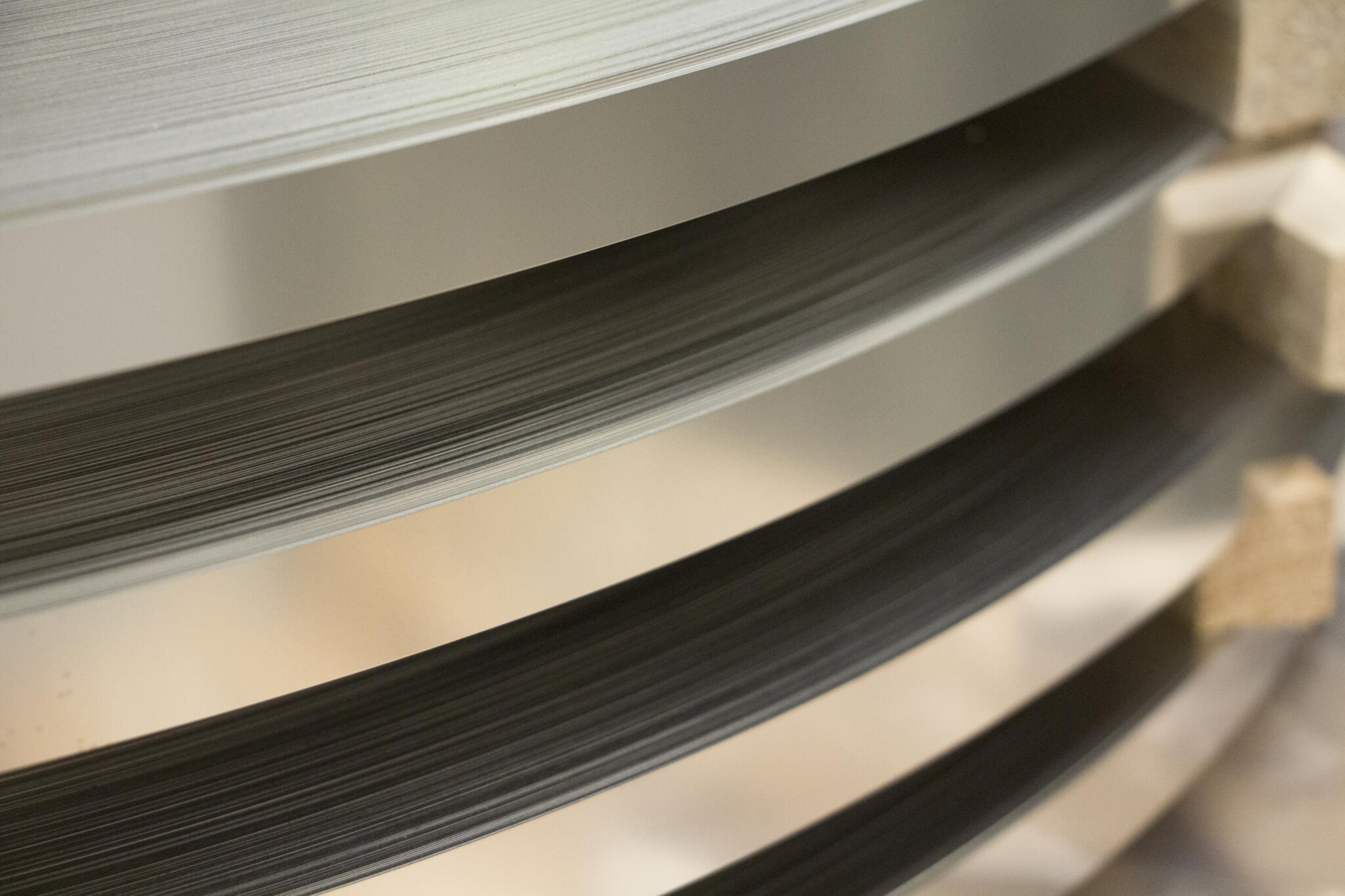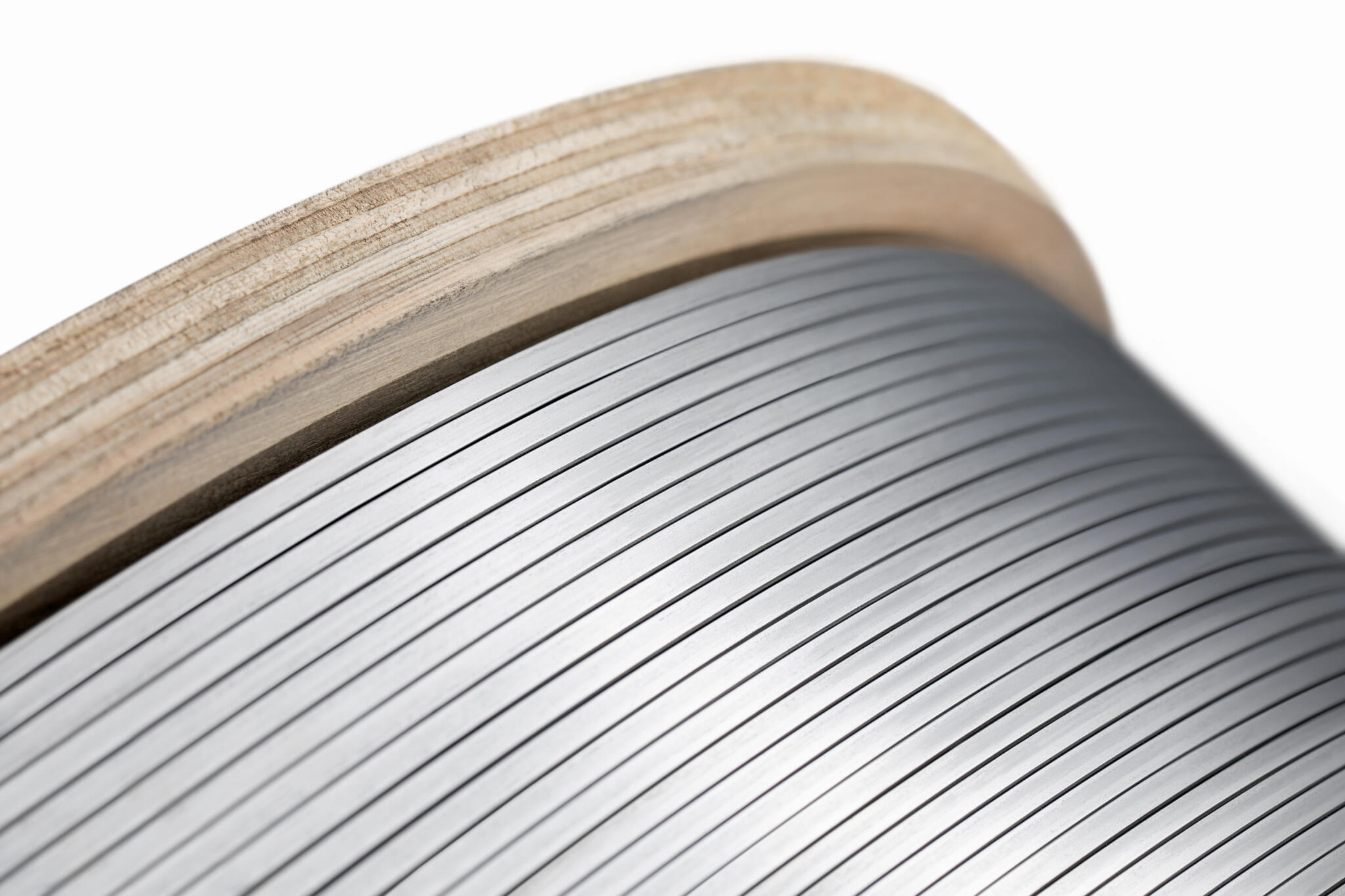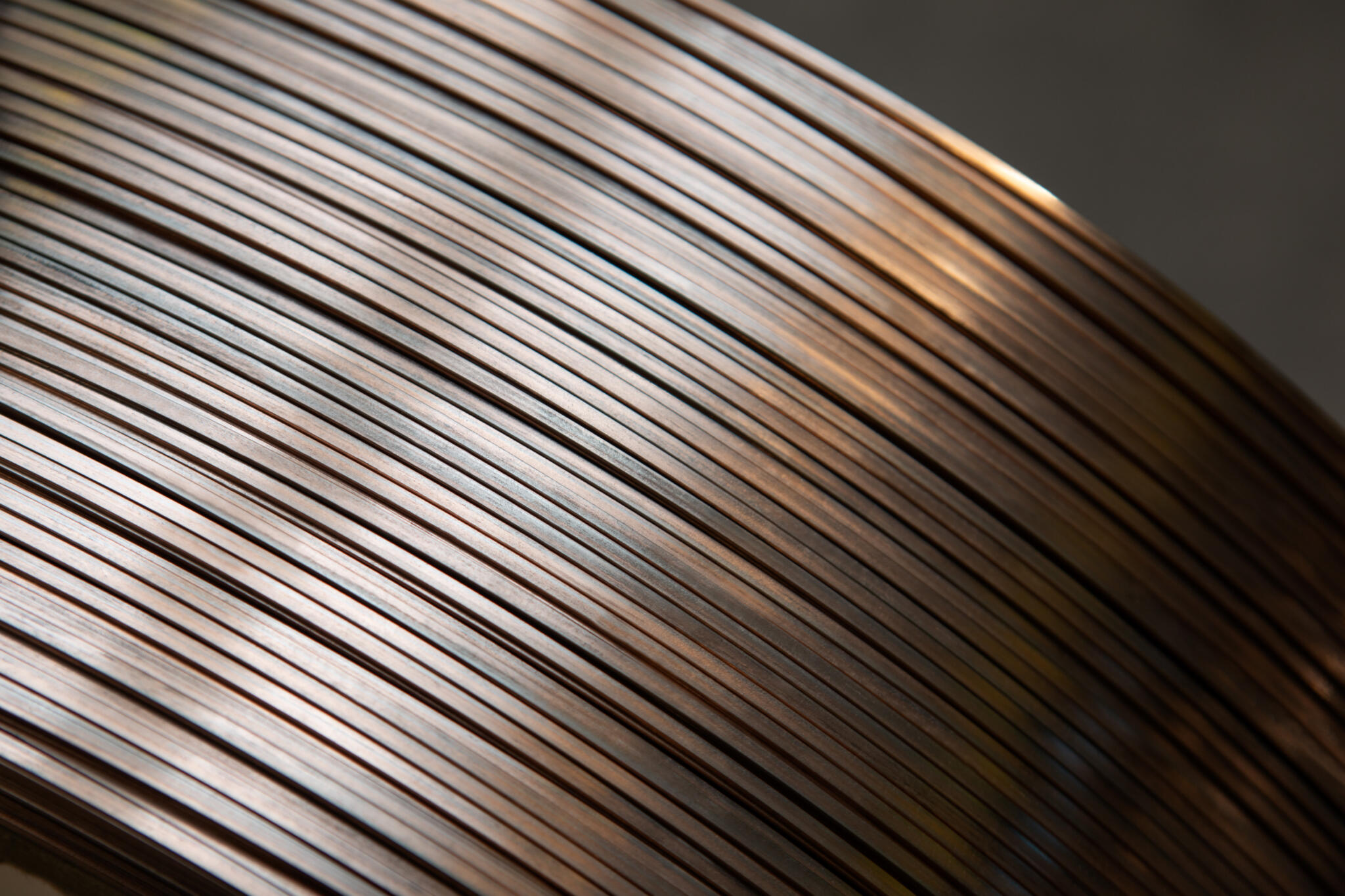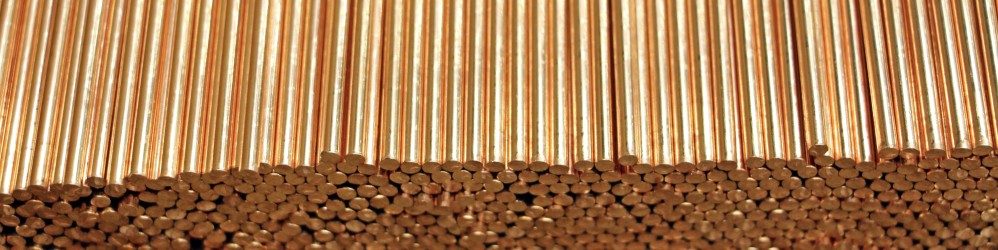

AISI 301 stainless steel strip (1.4310 / X10CrNi18-8) is the reference grade when a metal part has to be elastic, strong and corrosion resistant. Its secret lies in how it responds to cold rolling: starting from the same material, it can be supplied from a highly ductile annealed condition up to spring tempers exceeding 1,900 N/mm². This versatility makes it the stainless steel of choice for flat springs, clips and precision stamped components.
What is AISI 301 stainless steel strip?
What is AISI 301 stainless steel strip?
AISI 301 is an austenitic chromium-nickel stainless steel, from the same family as AISI 304. The difference lies in the balance of its composition: it contains slightly less nickel and chromium and slightly more carbon. As a result, its structure partially transforms when cold worked, and the material work-hardens far more than 304 with each rolling pass.
In strip form, this property is used to offer a range of standardised tempers. The manufacturer chooses the exact balance between formability and strength that the part requires.
It is designated differently depending on the market:
- Europe (EN): X10CrNi18-8 / 1.4310
- United States (AISI): 301
- Japan (JIS): SUS 301
- China (GB): 1Cr17Ni7
There is also the 1.4310 Mo (301Mo) variant, with a minimum molybdenum content agreed at the time of order.
Chemical composition of AISI 301 (1.4310)
| Element | Range (%) |
|---|---|
| Carbon (C) | 0.05 – 0.15 |
| Chromium (Cr) | 16.00 – 19.00 |
| Nickel (Ni) | 6.00 – 9.50 |
| Molybdenum (Mo) | ≤ 0.80 |
| Manganese (Mn) | ≤ 2.00 |
| Silicon (Si) | ≤ 2.00 |
| Nitrogen (N) | ≤ 0.11 |
| Phosphorus (P) | ≤ 0.045 |
| Sulphur (S) | ≤ 0.015 |
AISI 301 strip is supplied to EN 10088-2 (general purpose, annealed condition) and EN 10151 (stainless steel strip for springs, hardened condition).
AISI 301 strip tempers to EN 10151
This is the great advantage of 301. Depending on the degree of cold rolling, the strip is supplied in the following tempers:
| Condition | Designation | Tensile strength Rm (N/mm²) | Min. elongation (%) |
|---|---|---|---|
| Annealed | – | 600 – 950 | 40 |
| +C850 | 1/4 hard | 850-1,000 | 25 |
| +C1000 | 1/2 hard | 1,000-1,150 | 20 |
| +C1150 | 3/4 hard | 1,150-1,300 | 15 |
| +C1300 | 4/4 hard | 1,300-1,500 | 10 |
| +C1500 | 5/4 hard | 1,500-1,700 | 5 |
| +C1700 | K1 | 1,700-1,900 | 2 |
| +C1900 | K2 | 1,900-2,200 | 1 |
| +C2100 | – | On request | – |
In the annealed condition, the minimum yield strength is 250 N/mm² (Rp0.2, longitudinal) and 280 N/mm² (Rp1.0, transverse). Hardness ranges from 250 to 600 HV depending on the temper.
How to read the table: the harder the temper, the higher the strength and the lower the formability. 1/4 and 1/2 hard tempers allow moderate bending and drawing. The 4/4, 5/4, K1 and K2 tempers are reserved for spring parts with little deformation during forming.
For spring parts, a stabilising (tempering) heat treatment can be applied after forming. The VINCO strip catalogue includes guidance charts for this treatment for 1.4310 with and without molybdenum.
AISI 301 vs AISI 304: which one to choose?
Both are austenitic and share many applications, but they are not interchangeable when the part works as a spring.
| AISI 301 (1.4310) | AISI 304 (1.4301) | |
|---|---|---|
| Strength in annealed condition (Rm) | 600 – 950 N/mm² | 540 – 750 N/mm² |
| Hardest usual temper | +C1900 (K2), +C2100 on request | +C1300 (4/4 hard) |
| Elongation at +C1300 | 10% | 1% |
| Key strength | Elasticity and mechanical strength | Corrosion resistance and weldability |
| Typical use | Springs, clips, elastic parts | Formed parts, food-industry equipment |
At the same strength of 1,300 N/mm², 301 retains ten times more elongation than 304. If the part has to act as a spring, 301 is the natural choice. If corrosion resistance or welding is the priority, 304 is usually more suitable (we explain why in our article on AISI 304 wire).
What is AISI 301 stainless steel strip used for?
AISI 301 strip is found in any process that needs an elastic part that will not rust:
- Flat springs, springs and spring blades for industrial and automotive mechanisms
- Retaining clips, staples and clamps
- Spring washers and fastening elements
- Contacts and components for electronics and e-mobility
- Precision stamped parts in progressive dies
- Metal gaskets and sealing shims
Finishes, tolerances and supply formats
- Surface finishes: 2B or 2R (BA, bright annealed) in the annealed condition, and 2H in the hardened condition. According to EN 10151, average roughness is Ra < 0.5 µm from +C700 to +C1000, and Ra < 0.3 µm from +C1150 upwards.
- Tolerances: thickness and width to EN ISO 9445-1, in normal, fine (F) and precision (P) classes. Tighter tolerances by commercial agreement.
- Edges: sheared (GK) or special (SK), rolled with rounded edges or machined.
- Formats: coils slit to width, oscillate wound strip in coils of up to 2,000 kg, or strip profiled to customer drawing.
Custom AISI 301 strip from VINCO
At VINCO we process AISI 301 stainless steel strip as a service centre specialised in longitudinal slitting, with more than 75 years of experience within Lontana Group:
- Slitting from 0.05 mm to 5.0 mm thick and from 3 mm to 1,250 mm wide, on 8 slitting lines
- Stock of 301 and 301Mo in different tempers, alongside our other grades of stainless steel strip
- Premium slitting for bright finishes free of marks and scratches
- In-house oscillate winding to feed automatic lines with fewer coil changes
- Custom packaging: anti-corrosion VCI paper or film, wooden crates, seaworthy packaging and more
- Technical advice to choose the right temper for each part
To calculate the weight of a coil before ordering, use our strip calculator. You can follow raw material price trends in our metal prices section.
Do you need AISI 301 strip for your process?
Tell us what part you manufacture and we will help you define the grade, temper, tolerance and delivery format. Write to info@vinco.es, call us on (+34) 94 412 33 99, or visit the stainless steel strip section and fill in the contact form.