

Brass strip

MECHANICAL PROPERTIES EN 1652 / EN 1654 BRASS STRIP

DesignationsTensile strength RmConventional yield strength at 0.2% Rp0.2Elongation 1)HV hardness
N/mm²N/mm²A50mm for thicknesses up to 2.5 mm (inclusive) %A50mm for thicknesses above 2.5 mm %
MaterialMetallurgical conditionmin.max.min.max.min.max.
SymbolicNumericalmin.min.
CuZn10CW501LR2402402903645
H0505080
R2802803601320
H08080110
R35035048
H110110
CuZn15CW502LR2602603103645
H0555585
R3003003701625
H08585115
R350350420812
H105105135
R41041049034
H125125155
R4804805602
H150150180
R550550
H170170
CuZn30CW505LR3503504302125
H09595125
R410410490912
H120120155
R48048056046
H150150180
R5505506402
H170170200
R630630
H190190
CuZn33CW506LR2802803804050
H0555590
R3503504302331
H09595125
R420420500613
H125126155
R500500
H155155
CuZn37CW508LR3003003703846
H0555595
R3503504401928
H09595125
R410410490812
H120120155
R4804805603
H150150180
R550550
H170170
CuZn38Pb2CW608NR3403404203343
H07575110
R4004004801423
H110110140
R470470550612
H140140170
R540540
H165165
CuZn39Pb2CW612NR3603604403040
H09090120
R4204206001220
H120120150
R4904905709
H150150180
R560560
H175175

NOTE – The numbers in brackets are not standard requirements, they are given for information purposes only.

1) The values shown are for guidance purposes and are based on EN1652 and EN1654. For CuZn15 and CuZn30, the elongation values are in accordance with EN1652, thicknesses range from above 0.25mm to 1mm inclusive.

DesignationENChemical composition in % (mm)
SymbolicNumericalMin. CuMax. CuMax. AlMax. FeMax. NiMin. PbMax. PbMax. SnMin. ZnOthers total max.
CuZn10CW501LEN 165289.091.00.020.050.30.050.1Rest0.1
CuZn15CW502LEN 1654 / EN 165284.086.00.020.050.30.050.1Rest0.1
CuZn30CW505LEN 1654 / EN 165269.071.00.020.050.30.050.1Rest0.1
CuZn33CW506LEN 165266.068.00.020.050.30.050.1Rest0.1
CuZn37CW508LEN 165262.064.00.050.10.30.10.1Rest0.1
CuZn38Pb2CW608NEN 165260.061.00.050.20.31.62.50.2Rest0.2
CuZn39Pb2CW612NEN 165259.060.00.050.30.31.62.50.3Rest0.2

NOTE / EN 1652 and EN 13599: The total of other elements, except Cu, is defined as the sum of the contents of Ag, As, Bi, Cd, Co, Cr, Fe, Mn, Ni, O, P, Pb, S, Sb, Se, Si, Sn, Te and Zn excluding any element for which a value is individually specified.

DesignationENDensity 1) g/cm³
SymbolicNumericalapprox.
CuZn10CW501LEN 16528.8
CuZn15CW502LEN 1654 / EN 16528.8
CuZn30CW505LEN 1654 / EN 16528.5
CuZn33CW506LEN 16528.5
CuZn37CW508LEN 16528.4
CuZn38Pb2CW608NEN 16528.4
CuZn39Pb2CW612NEN 16528.4

1) For information purposes only.

THICKNESS TOLERANCES EN 13599 / EN 1652

Nominal thicknessThickness tolerance for nominal widths according to EN 13599/  EN 1652
>10 < and ≤ 200200 < and ≤ 350350 < and ≤ 700700 < and ≤ 10001000 < and ≤ 1250
normal (Class A)special (Class B)
0.05 1)0.1± 10% 2)
0.10.2± 0.010± 0.007± 0.015
0.20.3± 0.015± 0.010± 0.020± 0.03± 0.04
0.30.4± 0.018± 0.012± 0.022± 0.04± 0.05± 0.07
0.40.5± 0.020± 0.015± 0.025± 0.05± 0.06± 0.08
0.50.8± 0.025± 0.018± 0.030± 0.06± 0.07± 0.09
0.81.2± 0.030± 0.022± 0.040± 0.07± 0.09± 0.10
1.21.8± 0.035± 0.028± 0.06± 0.08± 0.10± 0.11
1.82.5± 0.045± 0.035± 0.07± 0.09± 0.11± 0.13
2.53.2± 0.055± 0.040± 0.08± 0.10± 0.13± 0.17
3.24.0± 0.10± 0.12± 0.15± 0.20
4.05.0± 0.12± 0.14± 0.17± 0.23
5.06.0± 0.14± 0.16± 0.20± 0.26

Measurements in mm.
1) Including the value 0.05.
2) ± 10% of the nominal thickness

THICKNESS TOLERANCE FOR COATED MATERIAL

EN 13148. The thickness of the tinned strip must meet the required combination of tolerances for the thickness of the strip (table above) and the range of thicknesses of the coatings ordered, for both sides.
EN 14436. The thickness of the strip prior to tinning must be in accordance with the approximate tolerances given in the table above. The thickness tolerance of the tinned strip must take into account the minimum and maximum thicknesses of the coating.

WIDTH TOLERANCES OF THE STRIPS

Nominal thickness tStandard slitting tolerances for VINCO 2)Width tolerances for nominal widths according to EN 13599/ EN 1654
<3-1515-5050-150>150up to & including 50over 50 and up to 100 inclusiveover 100 and up to 200 inclusiveover 200 and up to 350 inclusiveover 350 and up to 500 inclusiveover 500 and up to 700 inclusiveover 700 and up to 1250 inclusive
0,050,10;+0,21)
0,10,20;+0,153)0;+0,153)0;+0,153)0;+0,23)0;+0,20;+0,30;+0,40;+0,60;+1,00;+1,50;+2,0
0,20,40;+0,150;+0,150;+0,150;+0,20;+0,20;+0,30;+0,40;+0,60;+1,00;+1,50;+2,0
0,410;+0,170;+0,180;+0,20;+0,240;+0,20;+0,30;+0,40;+0,60;+1,00;+1,50;+2,0
11,50;+0,20;+0,20;+0,20;+0,30;+0,30;+0,40;+0,50;+1,00;+1,20;+1,50;+2,0
1,52on request0;+0,260;+0,30;+0,320;+0,30;+0,40;+0,50;+1,00;+1,20;+1,50;+2,0
22,5on request0;+0,260;+0,30;+0,320;+0,50;+0,60;+0,70;+1,20;+1,50;+2,00;+2,5
2,53on requeston request0;+0,320;+0,350;+1,00;+1,10;+1,20;+1,50;+2,00;+2,50;+3,0
35on requeston request0;+0,320;+0,350;+2,00;+2,30;+2,50;+3,00;+4,00;+5,00;+6,0

Measurements in mm.

1) Including the value t=0.05
2) Other, closer dimensional tolerances are possible under a commercial agreement .
3) Including the value t=0,1

LENGTH TOLERANCES 13599

Length tolerances of thick sheets, thin sheets and strips in cut lengths of up to 5000mm.
LengthNominal thicknessLength tolerance
Without rolling (M)up to & including 25±50
Fixed length (F)5 and above0; +10
over 5 and up to 10 inclusive0; +15

Measurements in mm.

EDGE CAMBER TOLERANCES

Nominal width (W)Edge curve tolerances under commercial agreementEdge curve tolerances according to the EN 13599 Standard
Maximum deviation
1000 mm
Thickness (t)
Maximum deviation
1000 mm
Thickness (t)
t ≤ 1.20 mmt > 1.20 mmt ≤ 0.5 mm0.5 < t ≤ 1.20 mm1.20 < t ≤ 2.50 mm2.50 < t ≤ 3.20 mm3.20 < t ≤ 5.00 mm
3 ≤ W < 62.504.00
6 < W ≤  102.003.00
10 < W ≤  151.001.507.00 1)10.00
15 < W ≤  201.001.504.006.008.00
20 < W ≤  300.501.004.006.008.00
30 < W ≤  500.501.003.004.006.007.00*under a commercial agreement
50 < W ≤  3500.501.002.003.004.005.00
350 < W ≤  12502.003.004.005.00

BARE MATERIAL

The strips must be clean and free of detrimental defects, which must be specified by agreement between the customer and the supplier when requesting the quote and in the order. Normally, a small residual layer of lubricant is left on cold-rolled products, which is authorised unless otherwise specified.

ROUGHNESS EN 1654

This must be agreed between the customer and the supplier when requesting the quote and confirming the order.

SURFACE CONDITION EN 13599

The strips must be clean and free of detrimental defects, which must be specified by agreement between the customer and the supplier in the request for quotes and in the order. Normally, a small residual layer of lubricant is left on cold-drawn products, and this is acceptable unless otherwise specified. Discolouration is acceptable, provided that it is not detrimental to the use of the product.

TIN COATINGS

Tin coatings for strips and copper strips and copper alloys:

Type of coatingStandard
ElectrolyticEN 14436
Hot dipEN 13148

ELECTROLYTIC EN 14436

ELECTROLYTIC TIN PROCESS TYPES AND TYPES OF TIN COATINGS AND TIN ALLOYS EN 14436

ProcessDescription
Process for matt electrolytic coatings.This is the standard finish of a traditional electrolytic bath.
Process for bright electrolytic coatings.Coatings with a bright appearance are obtained using baths that contain one or more suitable brightening agents (brighteners). Their presence may not be desirable in subsequent melting or soft soldering processes. Furthermore, they may be beneficial for frictional properties (low friction or sliding contacts).
Process for flow-brightened electrolytic coatings.Flow-brightened electrolytic coatings are obtained by heating a matt electrolytic coating above its melting point for a few seconds and then cooling it. The coatings preserve their sheen after cooling. In practice, flow brightening is not used for coatings with thicknesses above 5 μm (slip risk) or for coatings that are already bright.

NOTE – Tin electrolytic coatings may experience a spontaneous growth of metallic filaments (the combined effect of humidity and mechanical stresses, for example). This phenomenon is highly undesirable for electrotechnical applications (risk of short circuit). The risk of this occurring can be reduced by flow brightening, using tin-lead alloy coatings or inserting a suitable sublayer.

TYPES OF STEEL ELECTROLYTIC COATINGS AND TIN ALLOYS ACCORDING TO APPLICABLE EN 14436

Coating thickness μmTypes of coatings
min.max.Sn bright (Snb)Sn matt (Snm)Sn flow-brightened (Snf)
1AsN/AAs
0.81.2AsN/A*
1.52.5BAsB – R
24B – CRB – R
36B – CRN/A
5B – CR – CN/A

NOTE 1: Applications:

  • N/A:  not applicable
  • B:      improves the suitability for soft soldering
  • *:       reduces frictional forces
  • C:      corrosion resistance
  • R:      reduction of electrical resistance on a contact
  • As:    improved appearance

NOTE 2: These typical values are for information purposes and can be replaced by agreement between the customer and the supplier.

COMPOSITION OF THE TIN AND TIN ALLOYS EN 14436

Type of coatingDesignation of the materialComposition in % (mass fraction)
Min. SnOthers, total
Sn bright (Snb)Sn9999Remainder
Sn matt (Snm) or Sn flow-brightened (Snf)Sn99.5099.5Remainder

HOT DIP EN 13148

APPEARANCE EN 13148. HOT DIP TINNING
Thicknesses (average values) and preferred thickness ranges for coatings:
ThicknessThickness rangeApplication
µmµm
average valuefromup to & including
1.450.72.2Preventing surface oxidation, decorative appearance, reducing frictional forces.
213Preventing surface oxidation, decorative appearance, reducing frictional forces.
3.525Preventing corrosion
537Extending the useful life
7.5510To aid soft soldering
10713To aid soft soldering
The appearance depends on the type of liquid film cooling, the type of coating and the technique used to remove excess molten metal. The surface may have a bright or matt appearance, or a combination of both. The appearance of the coating does not affect its suitability. If there are special requirements for the appearance of the coating, these requirements must be agreed at the time of the quote and/or order.
Approximate international equivalents
SymbolicNumericalENAMERICANJAPANESECHINESE
USJISGB
CuZn10CW501LEN 1652
CuZn15CW502LEN 1654 / EN 1652
CuZn30CW505LEN 1654 / EN 1652
CuZn33CW506LEN 1652C26800C 2680
CuZn37CW508LEN 1652C27400C 2720H62
CuZn38Pb2CW608NEN 1652
CuZn39Pb2CW612NEN 1652

BRASS STRIP: COMPOSITION AND DETAILS

FINISHES AND TYPES OF COATINGS

Brass strip is intended for industrial or decorative applications and is composed of a copper-zinc alloy and other metals. Brass is a recyclable material highly resistant to oxidation and corrosion.

In addition to the possibility of supplying bare brass strip, the roughness (s/EN 1654) and the surface condition (s/EN 13599) are included in the Standard and must be agreed between customer and distributor.

Metal strip made of copper alloys is supplied with two types of electrolytic and hot-dip tin coatings.

The options available for the electrolytic type coating (s/EN 14436) are as follows:

  • Matte electrolytic coating: the result is a standard finish of a traditional electrolytic bath.
  • Bright electrolytic coating: brighteners are applied to the bath which may be undesirable with respect to subsequent melting or soft soldering operations, or on the contrary, beneficial with respect to friction properties.
  • Electrolytic reflow polishing coating: this coating is achieved by heating the matte electrolytic coating above its melting point and then cooling it. It is not applied on strips larger than 5µm due to the risk of slipping, nor for coatings that are already bright.

In addition to this coating, VINCO offers you the hot coating: hot dip tin plating (s/EN 13148). In this case, the brass strip is covered with a tin layer that protects, depending on the µm range, from surface oxidation. This coating gives the product a decorative appearance, reduces frictional forces, increases the service life and supports soft soldering.The surface appearance can be bright or dull, or a combination of both without affecting the suitability of the product. If you have doubts about which coating is more suitable for your case, please contact us.
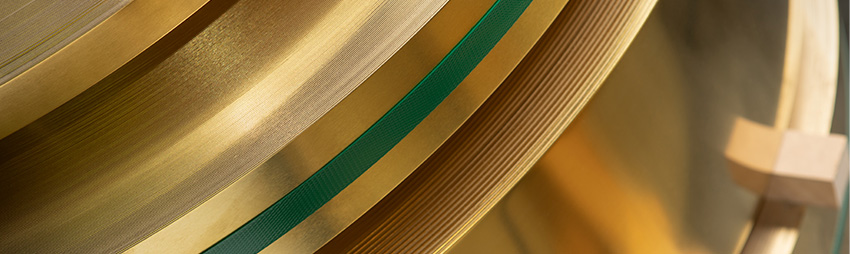
CAPACITIES AND SUPPLY OPTIONS FOR BRASS STRAPS

To determine the weight and dimensions of the coil, we have a weight calculator that takes into account the inside and outside diameter of the strip, based on the specific weight of the material. In the case of brass, regardless of the format in which it is delivered, it is 8.7 kg/dm³. In this way, you will have a more accurate data in reference to the weight.

The supply options available to us at VINCO fall into three main categories:

  • In Rolls with strapping: this type of packaging cordons off the strapping to provide greater stability when transporting the goods. Within this modality, the product can be supplied strapped by arrangement -radial or perimeter-, by material -plastic or metallic-, by coil arrangement (clockwise or counterclockwise), with separation between coils and with cardboard core.

  • The supply of spooled strapping takes advantage of the material giving uniformity to the strap with wooden, metallic, plastic or cardboard core reels. 

  • The Helycoil format strap incorporates cardboard separators that group the product in the form of a roll or cookie.

In addition, the packaging and palletizing in which we can supply strapping comes in different types of pallets: square, round, custom-made or europallet.

All these supply options and types of packaging include protective elements to ensure that the product arrives in perfect condition: box, lid, intermediate cardboard or wooden blocks, corner protectors, dustproof plastic bag, paper and VCI damp-proof plastic, phytosanitary and maritime packaging and damp-proof bags.